

Introduction
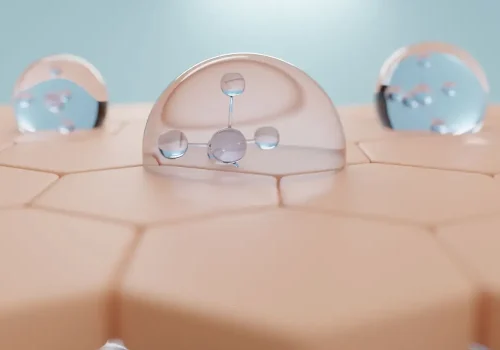
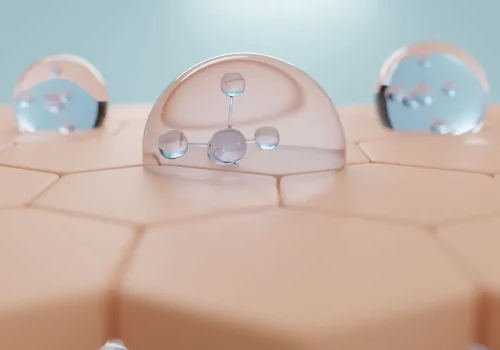
Regenerative medicine has acquired a fundamental role in the development of new therapeutic strategies aimed at the repair and regeneration of damaged tissues. Within this field, exosomes derived from mesenchymal stem cells have aroused growing interest due to their ability to modulate biological processes related to cell communication, proliferation, migration and tissue regeneration (Théry, Zitvogel & Amigorena, 2002).
These extracellular vesicles contain proteins, lipids, messenger RNA and microRNA that actively participate in cell repair mechanisms and inflammatory response (Yáñez-Mó et al., 2015).
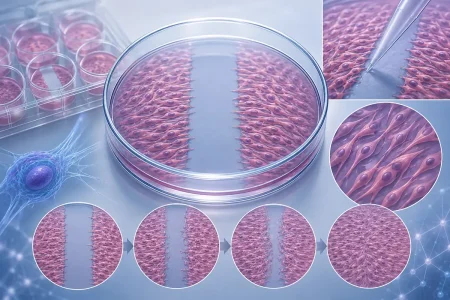
The present study aims to evaluate the effect of exosomes on the wound closure process in dermal fibroblasts using the technique known as Scratch Assay or wound closure assay. This method is a widely used tool in cell research to analyze the migratory capacity of cells in response to a simulated injury under controlled laboratory conditions (Liang, Park & Guan, 2007).
Cell migration represents an essential process in tissue healing and regeneration, especially in skin repair and in the restoration of tissue integrity.
Dermal fibroblasts play a key role in wound healing processes due to their involvement in extracellular matrix synthesis, collagen production, and tissue remodeling. Therefore, evaluating the behavior of these cells in response to exosome treatment allows us to determine the regenerative and biostimulatory potential of these biological components. In this context, the study compares an untreated control group with a group treated with refrigerated exosomes to observe differences in cell migration rate and wound closure over a 72-hour period.
Several studies have demonstrated that exosomes derived from mesenchymal stem cells can accelerate tissue repair by stimulating cell proliferation, promoting angiogenesis, and modulating inflammatory processes (Hu et al., 2016). Furthermore, these extracellular vesicles have been reported to represent a promising alternative to
conventional cell therapies, due to their stability, lower immunological risk and ease of storage and application (Zhang et al., 2015).
Therefore, this trial seeks to provide experimental evidence on the effectiveness of exosomes as regenerative agents, evaluating their ability to promote cell migration and accelerate the repair process in dermal fibroblasts.
The results obtained could contribute to the development of future therapeutic applications in regenerative medicine, dermatology, and tissue bioengineering.
- objective
Evaluate the effect of exosomes on wound closure in dermal fibroblasts.
- Methodology
Fibroblasts were cultured until a confluence greater than 80% was achieved and a slight wound, “scratch”, was made to simulate a wound.
Two groups were established:
- Control (without treatment)
- Treated with exosomes (stored for 1 month under refrigeration)
Images were taken at 24, 48 and 72 hours to assess wound closure.
- Results
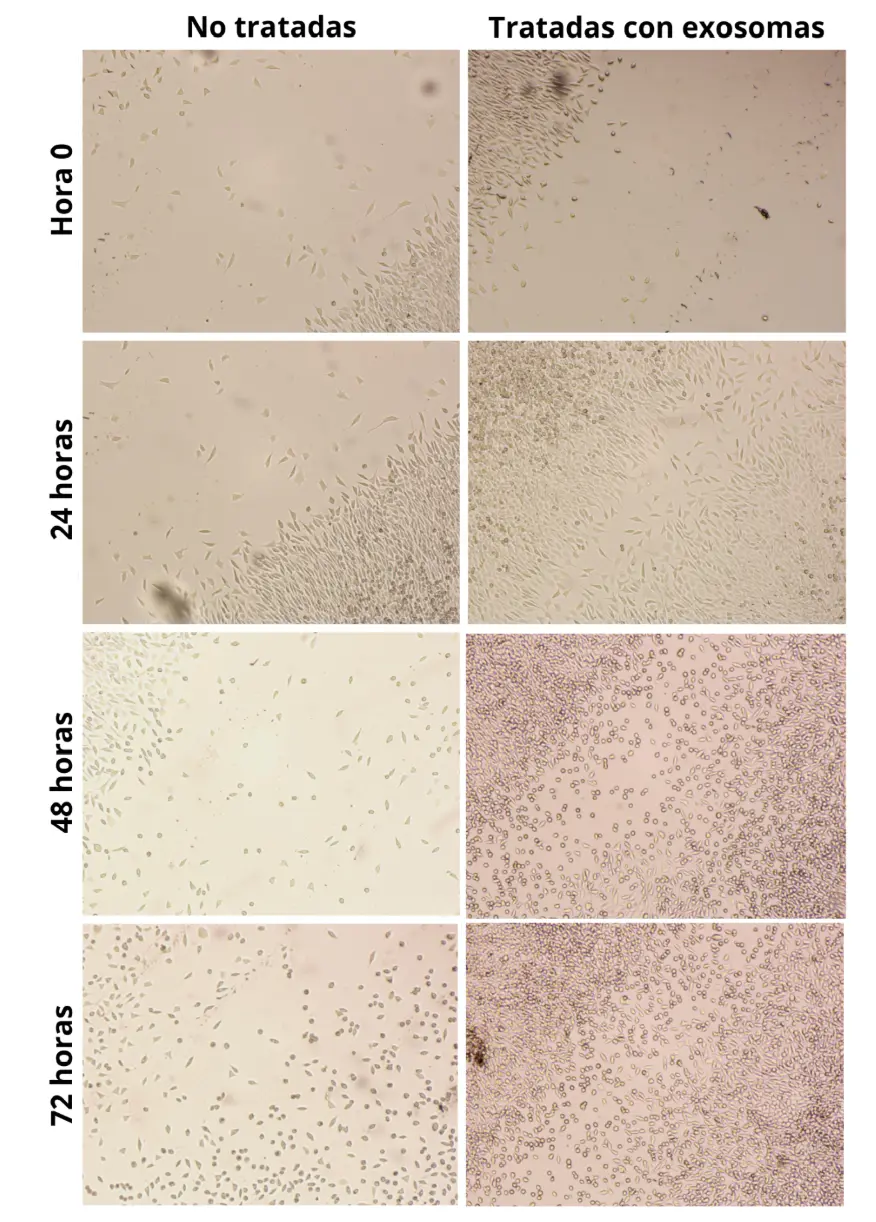
It was observed that the group treated with exosomes showed faster wound closure compared to the control group.
At 24 hours, greater cell migration was already evident in the treated group. This difference was clearer at 48 and 72 hours, where closure was more advanced, while the control group showed slower and incomplete closure.
- Conclusion
The wound closure assay performed with dermal fibroblasts demonstrated that exosomes stimulate cell migration, an important process in tissue regeneration. Unlike the untreated or control group, which showed no cell migration for wound closure after 24 hours, the group treated with exosomes showed active cell migration and significantly greater closure at 48 hours. These results support their efficacy as regenerative agents in cellular repair processes.
Bibliographic references
- Hu, L., Wang, J., Zhou, X. et al. Exosomes derived from human adipose mensenchymal stem cells accelerates cutaneous wound healing via optimizing the characteristics of fibroblasts. Sci Rep 6, 32993 (2016). https://doi.org/10.1038/srep32993
- Liang, CC., Park, A. & Guan, JL. In vitro scratch assay: a convenient and inexpensive method for analysis of cell migration in vitro. Nat Protoc 2, 329–333 (2007). https://doi.org/10.1038/nprot.2007.30
- Théry, C., Zitvogel, L. & Amigorena, S. Exosomes: composition, biogenesis and function. Nat Rev Immunol 2, 569–579 (2002). https://doi.org/10.1038/nri855.
- Yáñez-Mó, M., Siljander, P. R. M., Andreu, Z., Bedina Zavec, A., Borràs, F. E., Buzas, E. I., … De Wever, O. (2015). Biological properties of extracellular vesicles and their physiological functions. Journal of Extracellular Vesicles, 4(1). https://doi.org/10.3402/jev.v4.27066.
- Zhang, B., Wang, M., Gong, A., Zhang, X., Wu, X., Zhu, Y., Shi, H., Wu, L., Zhu, W., Qian, H., & Xu, W. (2015). HucMSC-Exosome Mediated-Wnt4 Signaling Is Required for Cutaneous Wound Healing. Stem cells (Dayton, Ohio), 33(7), 2158–2168. https://doi.org/10.1002/stem.1771